

This post may contain affiliate links! I will receive a commission, at no extra cost to you, if you purchase something recommended here.










No, New York is not part of New England.
New England is six states: Connecticut, Rhode Island, Massachusetts, Vermont, New Hampshire, and Maine.
New York sits in the Middle Atlantic, with New Jersey and Pennsylvania.
But for about one year, from 1688 to 1689, New York WAS governed as part of New England.
(It did not go well.)
I grew up in New Haven County, Connecticut; then, I moved to New York City and became a licensed NYC tour guide.
I’ve walked a lot of people down the street where the Dutch once built a wall to keep out an English invasion.
Plenty of New Englanders were rooting for that invasion. That street is now Wall Street.
Not one guest on my NYC tours has ever asked me this. Google, on the other hand, gets the question thousands of times a week. Let’s settle it.
So here’s the short answer, the real reasons behind it, and the year New York almost got a new name tag.
Quick Answers
- Is New York part of New England? No. New England is Connecticut, Rhode Island, Massachusetts, Vermont, New Hampshire, and Maine.
- What region is New York in? The Northeast. The Census Bureau puts it in the Middle Atlantic division with New Jersey and Pennsylvania.
- Why isn’t it part of New England? New York started as the Dutch colony of New Netherland. England didn’t take it until 1664, more than 40 years after English settlers founded Plymouth.
- Was New York ever part of New England? Briefly. In 1688 England folded New York and New Jersey into the Dominion of New England, which collapsed in 1689.
- Are New York City, upstate New York or New Jersey in New England? No, no, and no.
Is New York part of New England?
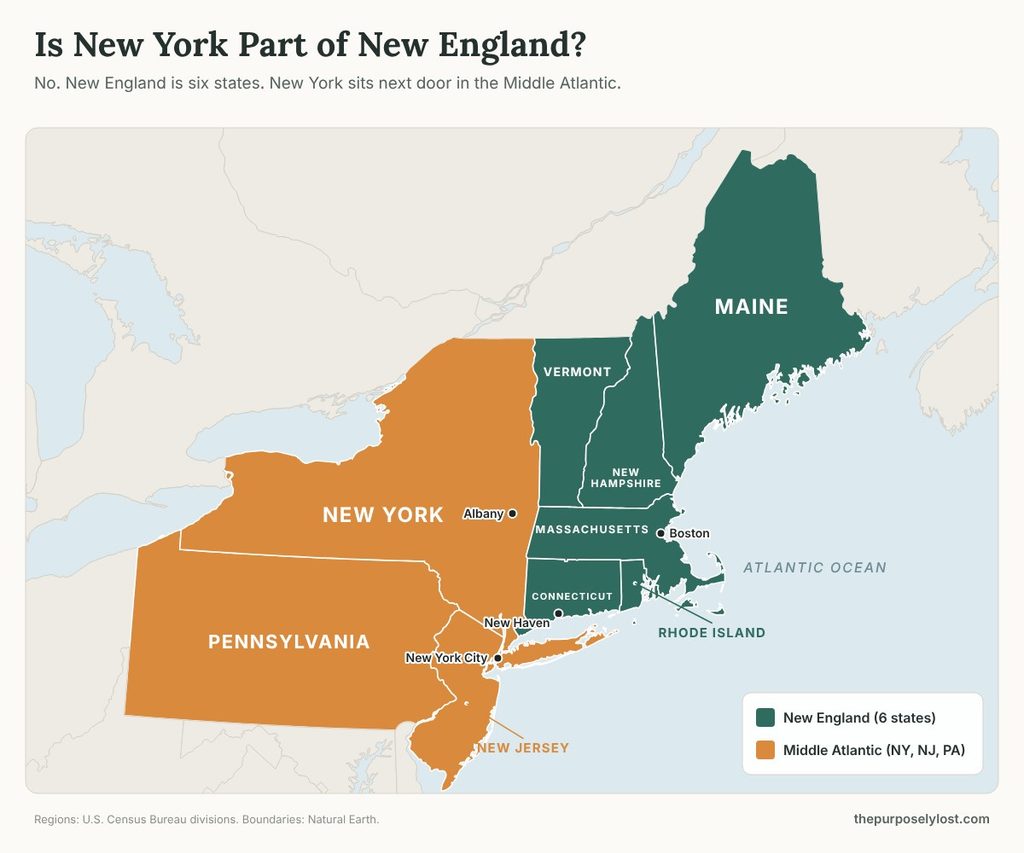
No. New York shares a long border with three New England states (Vermont, Massachusetts, and Connecticut), but it isn’t part of the region.
New England is the group of six states in the northeastern corner of the United States, and New York is its next-door neighbor to the west.
Want to see both? Start here
Why is New York not a part of New England?

New York isn’t part of New England because it began as a Dutch colony, New Netherland, while the English settled New England.
By the time England took New York in 1664, New England already had its own name, towns, and identity, and New York never merged into it.
The name came first.
Captain John Smith sailed this coast in 1614 and called it New England in his book and map, A Description of New England, published in 1616.
The Pilgrims landed in 1620 and founded Plymouth, the first New England colony that lasted.
More English colonies followed in Massachusetts Bay, Connecticut, Rhode Island, and New Hampshire.
Meanwhile, the Dutch were building something completely different around New York Harbor: a trading colony with its own language, its own laws, and its own idea of what the place was for (spoiler: beaver fur).
England didn’t take New Netherland until 1664. By then, New England was more than 40 years old.
New York showed up to the party four decades late. Speaking Dutch.
That split stuck.
When the U.S. Census Bureau drew up its nine divisions (they first appeared in 1910 census reports), it put the six New England states in one division and New York, New Jersey, and Pennsylvania in another, the Middle Atlantic.
A Brief History of New Amsterdam


Of the Dutch settlements in New Netherland, New Amsterdam is what we now know as New York City.
In the 1620s, Dutch colonists arrived in New York Harbor.
They built a small fort on what’s now Governors Island in 1624–25, then moved to Fort Amsterdam on the tip of Manhattan.
The Pilgrims came to New England looking for religious freedom.
The Dutch came to trade fur. Manhattan was full of wildlife at the time, and they were especially interested in beaver fur.
Unfortunately, it was kind of a mess.
People were getting sick, the government was poorly managed, and they didn’t have the tools or skills to successfully cultivate the land for crops.
In 1647, the Dutch sent a new director-general to New Amsterdam to whip it into shape: Peter Stuyvesant.
He had lost his right leg to a cannonball and wore a peg leg banded in silver (his nickname was “Old Silver Leg”); he was also known for being strict.
In 1653, with England and the Netherlands at war, Stuyvesant’s council planned a wall across the island, from the East River to the Hudson, to protect the town from an English attack.
According to the New Netherland Institute, many New Englanders thought it was the perfect time to invade.
The wall is long gone, but the street that ran along it is now Wall Street, one of the historic streets in Manhattan I love showing people.
The invasion came in 1664.
English warships sailed into the harbor, and on September 8, 1664, Stuyvesant signed the colony over without firing a shot.
New Amsterdam became New York, named for the Duke of York. The Dutch grabbed it back in 1673 and gave it up for good in 1674.
So the Dutch had about 40 years. What a run.
Was New York ever part of New England?


Yes, for about a year.
From 1688 to 1689, England governed New York and New Jersey as part of the Dominion of New England, a single royal colony stretching from Maine to New Jersey.
It collapsed in 1689, and New York has been its own thing ever since.
In 1686, King James II merged the New England colonies into one giant colony run by a royal governor, Sir Edmund Andros.
Then, on April 7, 1688, a new commission added “our Province of New York and East and West Jersey” to the list.
So for a moment, New York was officially part of New England.
Nobody loved it.
When word reached Boston that James II had lost his throne, colonists seized Andros on April 18, 1689, and the Dominion fell apart within weeks.
And that’s only the most official crossover. The line between New York and New England has been blurry from the start.
The Long Island town governed from New Haven

In 1640, settlers from New Haven founded Southold on the North Fork of Long Island, and in 1643 it joined New Haven Colony, which once covered my corner of Connecticut.
Southold sent representatives to New Haven’s court and paid New Haven’s taxes.
When England took New York in 1664, Long Island went to New York, and the East End towns were not happy about it.
According to the Brooklyn Historical Society, they refused to elect officials or pay New York’s taxes, and when the Dutch briefly returned in 1673, they asked Connecticut to take them back.
Today, Long Island doesn’t feel like New England to me at all. It’s like a cousin of New York City, but it’s very much its own place.
Fishers Island: New York, by way of Connecticut
Fishers Island belongs to the town of Southold, New York, but it sits about two miles off the Connecticut coast and about 11 miles from the tip of Long Island.
To get there, you take the ferry from New London, Connecticut.
New York’s title to the island was confirmed (again) by a joint Connecticut–New York commission in 1879.
If you’re nearby, my guide to the beaches in New London is a good place to start.
The time New York claimed Vermont

New York did let Vermont go. For a price.
Before Vermont was a state, New York and New Hampshire both claimed its land.
In 1777, Vermont got tired of waiting and declared itself an independent republic.
New York finally dropped its claim in October 1790, in exchange for $30,000, and Vermont became the 14th state on March 4, 1791.
What region is New York?

New York is in the Northeast.
More precisely, the U.S. Census Bureau puts it in the Middle Atlantic division with New Jersey and Pennsylvania.
The six New England states make up the Northeast’s other division.
In everyday use, “Mid-Atlantic” often stretches south to Delaware, Maryland and Washington, D.C., and sometimes Virginia and West Virginia.
The Census Bureau puts those in a different division, the South Atlantic.
And when New Yorkers say “the tri-state area,” they usually mean New York, New Jersey and Connecticut.
So one New England state made it into New York’s favorite nickname for its own neighborhood anyway.
What are the 6 New England states?


The six New England states are Connecticut, Rhode Island, Massachusetts, Vermont, New Hampshire, and Maine.
English colonists began settling the region in the 1620s, starting with Plymouth, Massachusetts, in 1620.
New England is a region, not a state.
These six states share similar geography, with mountains, rivers, lakes, and forests, and they have a lot in common when it comes to culture and history.
Connecticut is an interesting mix of New England.
The towns closest to New York feel more metropolitan, but the center and north of the state are New England through and through, and our shoreline is quintessential New England.
Then there’s fall in Connecticut.
The way the trees transform is spectacular, and everyone deserves to see it at least once.
Sports are where it gets messy.
The closer you get to New York, the more New York fans you’ll find, and the closer you get to Massachusetts, the more New England fans.
In the center of the state, where I grew up, it’s a mix of Red Sox and Yankees, Giants, Jets, and Patriots.
There’s no town line that decides it. You just never know.
Connecticut is the New England state closest to New York City, and plenty of people live there and commute in.
Here are my favorite Connecticut towns with easy commutes to NYC.
Why is New England only six states?
New England grew out of the colonies English settlers founded in the 1600s.
Two of today’s six came later: Vermont became a state in 1791 after its tug-of-war with New York, and Maine was part of Massachusetts until it became a state on March 15, 1820.
Is New Jersey part of New England?
No. New Jersey is in the Middle Atlantic with New York and Pennsylvania, not in New England. Like New York, it started out as part of the Dutch colony of New Netherland.
In 1664, King Charles II handed the land to his brother, the Duke of York, who passed the New Jersey part to two supporters, John Lord Berkeley and Sir George Carteret.
It was later split into East Jersey and West Jersey, and reunited under one royal charter in 1702.
And yes, East and West Jersey were folded into the Dominion of New England in 1688, right along with New York.
New Jersey does have one very New England fingerprint.
Puritans from Milford, Connecticut, founded Newark in 1666 under Robert Treat, and a second group from Branford, Connecticut, arrived in 1667.
One more for the road: the New York Giants and the New York Jets play their home games in East Rutherford, New Jersey.
State lines around here have always been more of a suggestion.
Is upstate New York part of New England?


Unfortunately, upstate New York is not part of New England.
It shares a lot with its neighbors, from the weather and the farms to beautiful fall foliage, and it even shares Lake Champlain with Vermont.
But upstate is still New York, and it isn’t included in the New England area.
Upstate New York feels much more like New England to me than New York City does.
It has the nature, the small towns and the suburbs, plus the same kind of mountains, weather and fall color, and
I’d guess that’s why so many people mix the two up.
But being part of New England comes down to history, and upstate’s history runs through New York.
What is New York State famous for?


New York State is in the northeastern United States.
It borders Vermont, Massachusetts, and Connecticut to the east, New Jersey and Pennsylvania to the south, and Lake Erie, Lake Ontario, and Canada to the north and west.
It even shares a water boundary with Rhode Island, and New York City and Long Island sit on the Atlantic Ocean.
The capital, Albany, has about 100,000 people.
New York has some of the most famous natural landmarks in the United States.
The Adirondacks and the Catskills are both inside its borders, along with Niagara Falls, a group of waterfalls on the Canadian border.
The Finger Lakes are eleven long, narrow lakes that look like fingers on a map, and New York shares Lake Champlain with Vermont.
The Hudson River Valley is another favorite for anyone who wants nature within reach of the city.

Franklin D. Roosevelt, the 32nd president of the United States, was born in Hyde Park, just outside Poughkeepsie, and his Presidential Library and Museum is there too.
And, of course, New York State is home to New York City, one of the most incredible cities in the world.
If you want NYC’s history, landmarks, and things to do, my Exploring New York page has all of my guides to the Big Apple.
New York vs. New England at a glance


| New York | New England | |
|---|---|---|
| What it is | One state | A region of six states |
| First European colony | Dutch: New Netherland (fort on Governors Island, 1624–25) | English: Plymouth (1620) |
| Became English | 1664 | From the start |
| Census division | Middle Atlantic (with New Jersey and Pennsylvania) | New England |
| Ever joined? | Part of the Dominion of New England, 1688–1689 | The Dominion was created for New England first (1686) |
| Shared with each other | Lake Champlain (with Vermont), Long Island Sound (with Connecticut) | Same |
New York and New England: FAQs

Is New York City in New England?
No. New York City is in New York state, which the Census Bureau places in the Middle Atlantic. The closest New England state to NYC is Connecticut.
Is New England a state?
No. New England is a region made up of six states: Connecticut, Rhode Island, Massachusetts, Vermont, New Hampshire, and Maine.
What is the capital of New England?
There isn’t one, because New England isn’t a state. Each of the six states has its own capital.
Is Connecticut part of New York?
No. Connecticut is one of the six New England states. It borders New York, and many people in southwestern Connecticut commute into New York City, which is why it’s part of what New Yorkers call the tri-state area.
Is Long Island part of New England?
No, Long Island is part of New York. But in the 1640s, the town of Southold on Long Island’s North Fork was part of New Haven Colony, until England gave Long Island to New York in 1664.
Is Pennsylvania part of New England?
No. Pennsylvania is in the Middle Atlantic with New York and New Jersey.
Was New York one of the New England colonies?
No. New York began as the Dutch colony of New Netherland and became an English colony in 1664. It was only governed as part of New England during the short-lived Dominion of New England, from 1688 to 1689.
Is New York Part of New England: Wrap-Up
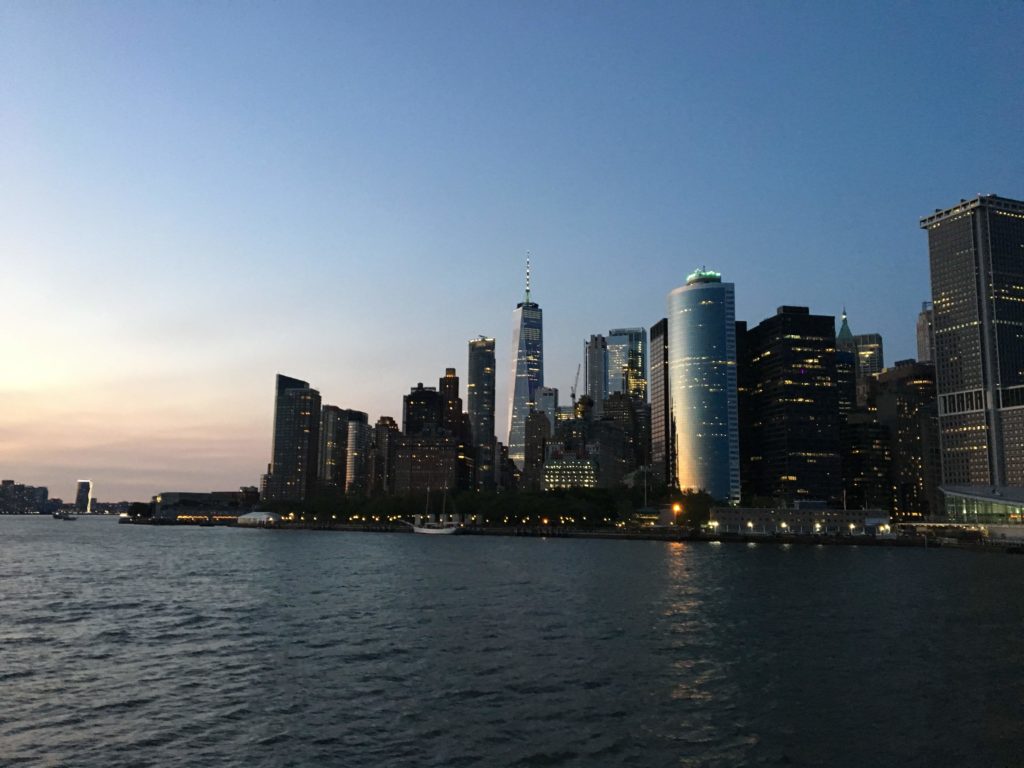
New York isn’t part of New England, and it hasn’t been since one awkward year in 1688.
But the line between them is blurrier than any map shows: a Long Island town once governed from New Haven, a New Jersey city founded by Connecticut Puritans, and a Wall Street that started as a wall against an English invasion.
If you have the chance, explore both. Start with my guide to New York City, then head north for a New England winter getaway.
Read this next: Fall Foliage Tours from New York City





Leave a Reply